Positive Technology Visions
Manifesto
The vision talks are about creating inspiration and exchanging ideas. The key point is to foster exchange and share inspiration in the intersection between technology, science and art. However, to not produce repetition/competition, the series adds a slightly different spiel with the focus on positive visions and interdisciplinary work grounded in research which could be industrial, arts-based or science-based. The series was inspired by the amazing seminars run by Uppsala on HCI.
Thus, white papers, early research ideas, societal impact work or positive provocations for a better tomorrow can be presented.
Where to find the Seminars?
Just look under Current Seminars to find the times and links to the live sessions!
Next Seminar: 10th of March, 13:15 (CET)
-
Speakers: María José Zapata Campos (GU, SV)
-
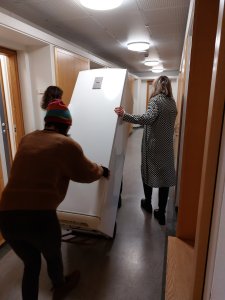
Topic: More Than a Fridge: Care, Food, and the University as a Threshold Space
-
Link: Zoom
-
Bio: María José Zapata Campos is professor of management and organization, and senior lecture at the School of Global Studies, University of Gothenburg, where she coordinates the ”Circular Grassroots” research project, the “Managing Big Cities” research program and the “Grassroots for Sustainability” research group. Her research focuses on organizing sustainability and environmental initiatives in cities, with an emphasis on grassroots movements and inclusive governance. Since 2025, she is also Research Director at the Swedish International Centre for Local Democracy leading research initiatives to empower local democracies and address global inequalities. María José’s recent publications include studies on waste commoning, grassroots infrastructures, and migrant women’s cooperatives.
-
Abstract: Approximately one-third of all food produced globally is lost or wasted, amounting to about 1.3 billion tonnes annually. At the local level, citizen-driven initiatives often struggle to find non-commercial spaces where they can express their creativity, practice sustainability, and engage in a just green transition from the grassroots. Frustrated by previous research projects that revealed the shrinking of these caring spaces and infrastructures in our growing city, a group of researchers at the University of Gothenburg decided to experiment with our own facilities by opening them up to the community. This initiative led to the creation of a food sharing initiative at the School of Business, known as the Solidarity Fridge, four years ago. The journey has been challenging, as we navigated bureaucracy, a culture of strict public space control, organizational resistance to change, and misconceptions that citizen-driven initiatives are merely philanthropic rather than climate action measures. In this presentation, I will share our story and discuss how, through the ongoing research project Circular Grassroots, we have examined our actions using participatory observations, action and co-production research, and participatory photo elicitation with participants. I will present preliminary findings suggesting that when infrastructures of care, such as the Solidarity Fridge, are integrated with existing educational and work infrastructures, such as Universities, they support broader societal change. Furthermore, I will explore how universities can create threshold spaces linked to these alternative infrastructures of care. These thresholds open enclosed spaces to the outside world, facilitating encounters between diverse life courses and social groups that might not otherwise meet. I argue that this activist research contributes to more than just reducing food waste: it transforms care receivers into caregivers, embodying the notion of homo curans—the caring human—and challenges the development of a city of enclaves by building a city of thresholds. In such a city, universities, and research activism, play a fundamental role in creating open landscapes where citizens can practice sustainability and participate in a just transition.
Format
The talks are 15min and then 20min for discussion. The talks are spaces out over the year to not create pressure and will ocure on each 2nd Tuesday in a month (except for the summer break).
Want to contribute or know more?
Interested in attending the seminar on zoom or have a topic to share / have an idea for whom to invite?
Just contact Swen via email or LinkedIn and let him know that we should put you on the list.